
 0xsha/cloudbrute
Uncover a target's cloud infrastructure, files, and apps across major providers (AWS, Azure, GCP) using unauthenticated enumeration with concurrent scanning and proxy support.

A tool to find a company (target) infrastructure, files, and apps on the top cloud providers (Amazon, Google, Microsoft, DigitalOcean, Alibaba, Vultr, Linode). The outcome is useful for bug bounty hunters, red teamers, and penetration testers alike.
The complete writeup is available. here
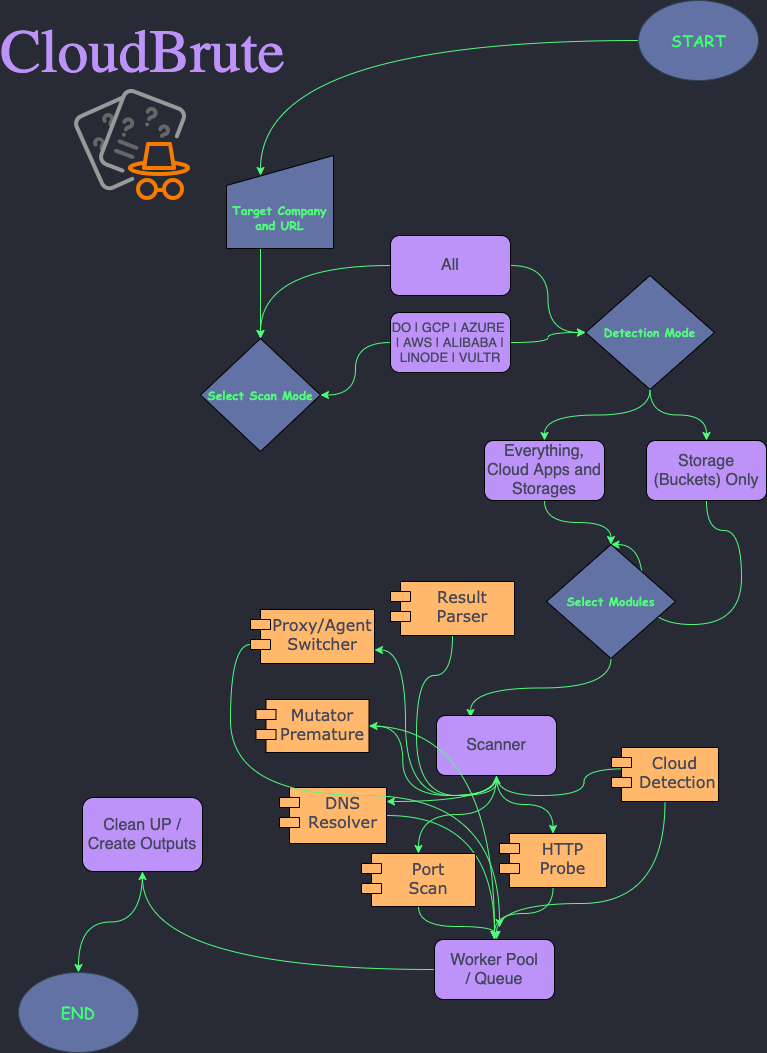
we are always thinking of something we can automate to make black-box security testing easier. We discussed this idea of creating a multiple platform cloud brute-force hunter.mainly to find open buckets, apps, and databases hosted on the clouds and possibly app behind proxy servers.
Here is the list issues on previous approaches we tried to fix:
Microsoft:
Amazon:
Google:
DigitalOcean:
Vultr:
Linode:
Alibaba:
1.0.0
Just download the latest release for your operation system and follow the usage.
To make the best use of this tool, you have to understand how to configure it correctly. When you open your downloaded version, there is a config folder, and there is a config.YAML file in there.
It looks like this
providers: ["amazon","alibaba","amazon","microsoft","digitalocean","linode","vultr","google"] # supported providers
environments: [ "test", "dev", "prod", "stage" , "staging" , "bak" ] # used for mutations
proxytype: "http"  # socks5 / http
ipinfo: ""      # IPINFO.io API KEY
For IPINFO API, you can register and get a free key at IPINFO, the environments used to generate URLs, such as test-keyword.target.region and test.keyword.target.region, etc.
We provided some wordlist out of the box, but it's better to customize and minimize your wordlists (based on your recon) before executing the tool.
After setting up your API key, you are ready to use CloudBrute.
 ██████╗██╗      ██████╗ ██╗   ██╗██████╗ ██████╗ ██████╗ ██╗   ██╗████████╗███████╗
██╔════╝██║     ██╔═══██╗██║   ██║██╔══██╗██╔══██╗██╔══██╗██║   ██║╚══██╔══╝██╔════╝
██║     ██║     ██║   ██║██║   ██║██║  ██║██████╔╝██████╔╝██║   ██║   ██║   █████╗
██║     ██║     ██║   ██║██║   ██║██║  ██║██╔══██╗██╔══██╗██║   ██║   ██║   ██╔══╝
╚██████╗███████╗╚██████╔╝╚██████╔╝██████╔╝██████╔╝██║  ██║╚██████╔╝   ██║   ███████╗
 ╚═════╝╚══════╝ ╚═════╝  ╚═════╝ ╚═════╝ ╚═════╝ ╚═╝  ╚═╝ ╚═════╝    ╚═╝   ╚══════╝
                                                V 1.0.7
usage: CloudBrute [-h|--help] -d|--domain "<value>" -k|--keyword "<value>"
                  -w|--wordlist "<value>" [-c|--cloud "<value>"] [-t|--threads
                  <integer>] [-T|--timeout <integer>] [-p|--proxy "<value>"]
                  [-a|--randomagent "<value>"] [-D|--debug] [-q|--quite]
                  [-m|--mode "<value>"] [-o|--output "<value>"]
                  [-C|--configFolder "<value>"]

                  Awesome Cloud Enumerator

Arguments:

  -h  --help          Print help information
  -d  --domain        domain
  -k  --keyword       keyword used to generator urls
  -w  --wordlist      path to wordlist
  -c  --cloud         force a search, check config.yaml providers list
  -t  --threads       number of threads. Default: 80
  -T  --timeout       timeout per request in seconds. Default: 10
  -p  --proxy         use proxy list
  -a  --randomagent   user agent randomization
  -D  --debug         show debug logs. Default: false
  -q  --quite         suppress all output. Default: false
  -m  --mode          storage or app. Default: storage
  -o  --output        Output file. Default: out.txt
  -C  --configFolder  Config path. Default: config
for example
CloudBrute -d target.com -k target -m storage -t 80 -T 10 -w "./data/storage_small.txt"
please note -k keyword used to generate URLs, so if you want the full domain to be part of mutation, you have used it for both domain (-d) and keyword (-k) arguments
If a cloud provider not detected or want force searching on a specific provider, you can use -c option.
CloudBrute -d target.com -k keyword -m storage -t 80 -T 10 -w -c amazon -o target_output.txt

Read the usage.
Make sure you read the usage correctly, and if you think you found a bug open an issue.
It's because you use public proxies, use private and higher quality proxies. You can use ProxyFor to verify the good proxies with your chosen provider.
change -T (timeout) option to get best results for your run.
Inspired by every single repo listed here .
