Skip to content
KitploitKITPLOIT
ToolsBlog
Submit
ToolsBlog
Submit

Hacking, PenTest, and Cybersecurity Tools for Your Security Arsenal!

Kitploit is a directory of hacking, cybersecurity, and pentesting tools. Discover the latest project updates to find vulnerabilities, analyze systems, automate testing, and strengthen your security.

··Feeds·Contact·Privacy·© 2026 Kitploit

Tool Directory

Categories

View all categories
Loading categories
RemoteTLSCallbackInjection — Utilizing TLS callbacks to execute a payload without spawning any threads in a remote process | Kitploit
Tools/GitHubGitHub/maldev-academy/remotetlscallbackinjection
ShellcodeLearning & EducationBinary ExploitationLabs & Practice
GitHubmaldev-academy/remotetlscallbackinjection

RemoteTLSCallbackInjection

Utilizing TLS callbacks to execute a payload without spawning any threads in a remote process

View Repository

Most Popular

View all →

Discover the most used tools by our community.

Explore all tools

Browse our collection of tools

View all tools →
Share
2914932 years agoReviewed by Kitploit

Maldev Academy - RemoteTLSCallbackInjection

Quick Links

Maldev Academy Home

Maldev Academy Syllabus

Related Maldev Academy Modules

New Module 34: TLS Callbacks For Anti-Debugging

New Module 35: Threadless Injection

Overview

This method utilizes TLS callbacks to execute a payload without spawning any threads in a remote process. This method is inspired by Threadless Injection as RemoteTLSCallbackInjection does not invoke any API calls to trigger the injected payload.

Implementation Steps

The PoC follows these steps:

  1. Create a suspended process using the CreateProcessViaWinAPIsW function (i.e. RuntimeBroker.exe).
  2. Fetch the remote process image base address followed by reading the process's PE headers.
  3. Fetch an address to a TLS callback function.
  4. Patch a fixed shellcode (i.e. g_FixedShellcode) with runtime-retrieved values. This shellcode is responsible for restoring both original bytes and memory permission of the TLS callback function's address.
  5. Inject both shellcodes: g_FixedShellcode and the main payload.
  6. Patch the TLS callback function's address and replace it with the address of our injected payload.
  7. Resume process.

The g_FixedShellcode shellcode will then make sure that the main payload executes only once by restoring the original TLS callback's original address before calling the main payload. A TLS callback can execute multiple times across the lifespan of a process, therefore it is important to control the number of times the payload is triggered by restoring the original code path execution to the original TLS callback function.

Demo

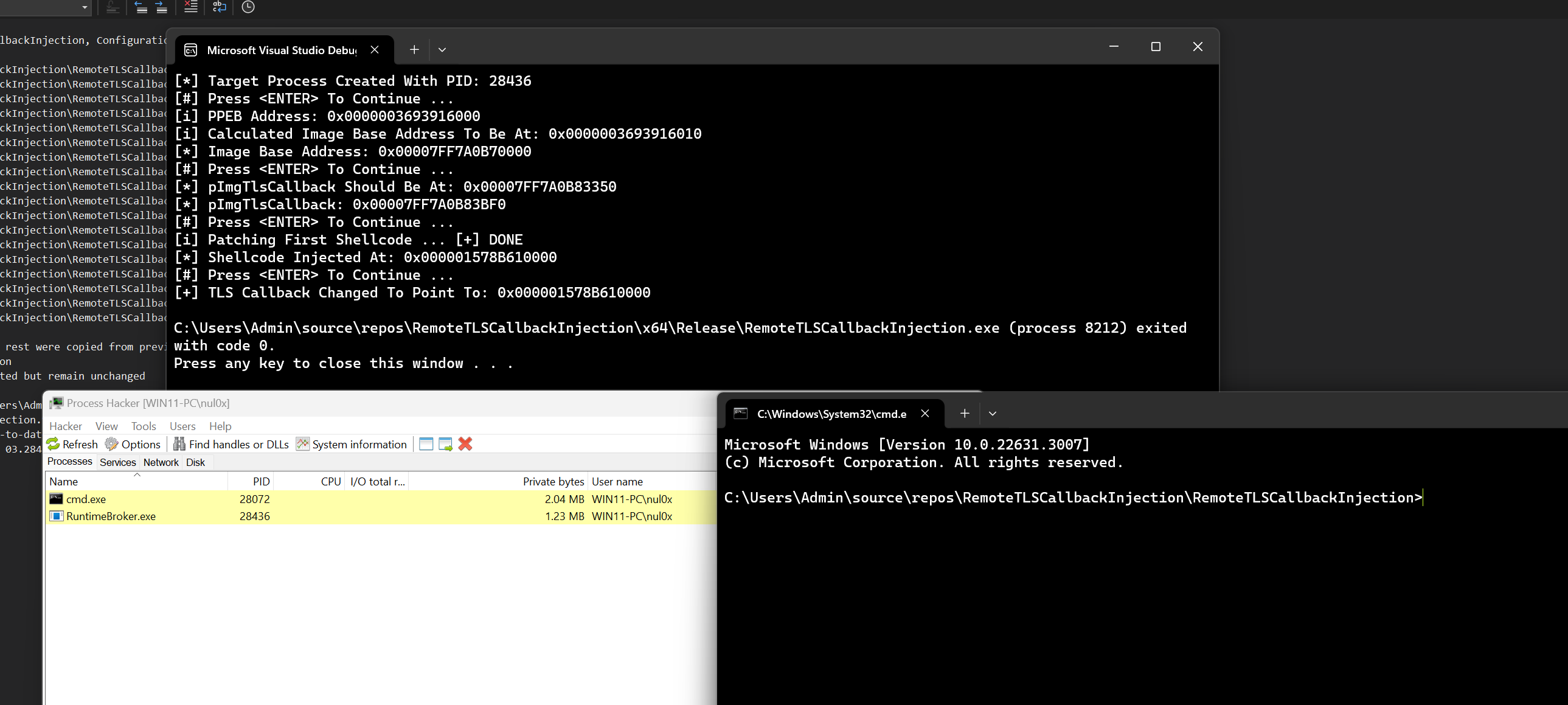
The following image shows our implementation, RemoteTLSCallbackInjection.exe, spawning a cmd.exe as its main payload.
demo
Download Tool