 gmh5225/harald
An in-memory minimal CPU for agnostic on-the-fly protocols creation

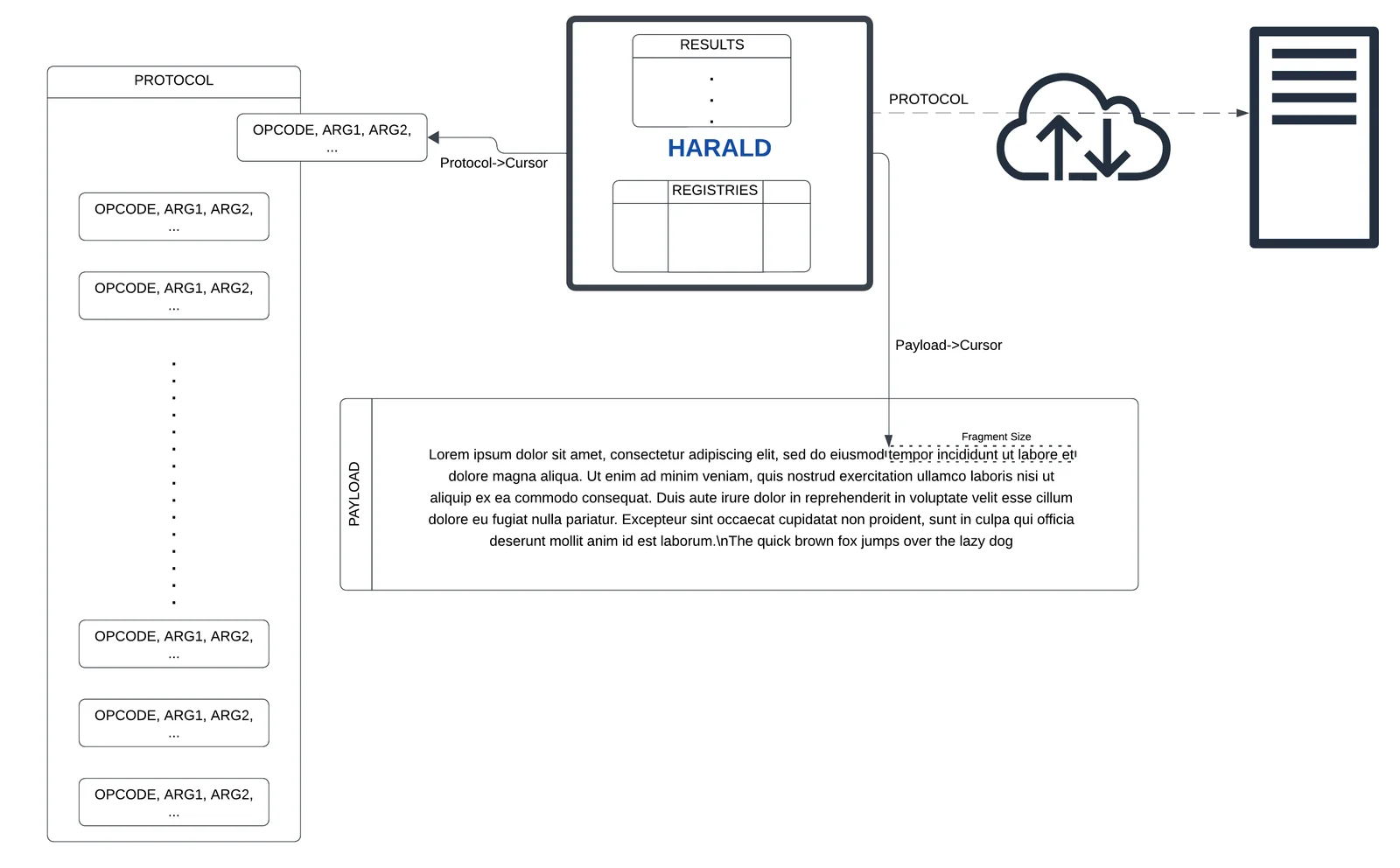
Harald is an in-memory tiny high-level CPU, able to process a set of instructions to generate application-layer protocols to be used over a given network protocol (TCP/UDP).
Harald will consume a stream of OPCODES and apply different transformations to the payload for it to be suitable for the defined application-layer protocol.
[!TIP] Why Harald? You may know Harald Gormsson, king of Denmark, for his nickname: Blátǫnn, or how we pronounce it nowadays, Bluetooth. The technology was named after Harald's nickname as he connected the Danish and Viking kingdoms back then. So I'm naming this after his firstname.
Harald behaves as a CPU. It follows a set of OPCODES that define actions. A PROTOCOL. Harald will process the required operations to create the required protocol on the fly.
Once the PROTOCOL is provided, Harald will iterate over the PAYLOAD to be sent by traversing the entire PROTOCOL once for every fragment. I.e.: If the payload had to be split in multiple fragments, Harald will use the same protocol for every fragment, executing every action defined in the protocol against the current payload fragment.
Harald holds a number of registries to be used by the protocol to store values. These registries can be used to perform multiple operations, such as addition, substraction, encoding and decoding... etc.
Harald dynamically allocates an array of results where the protocol can store the responses to each request performed upon sending a payload fragment.
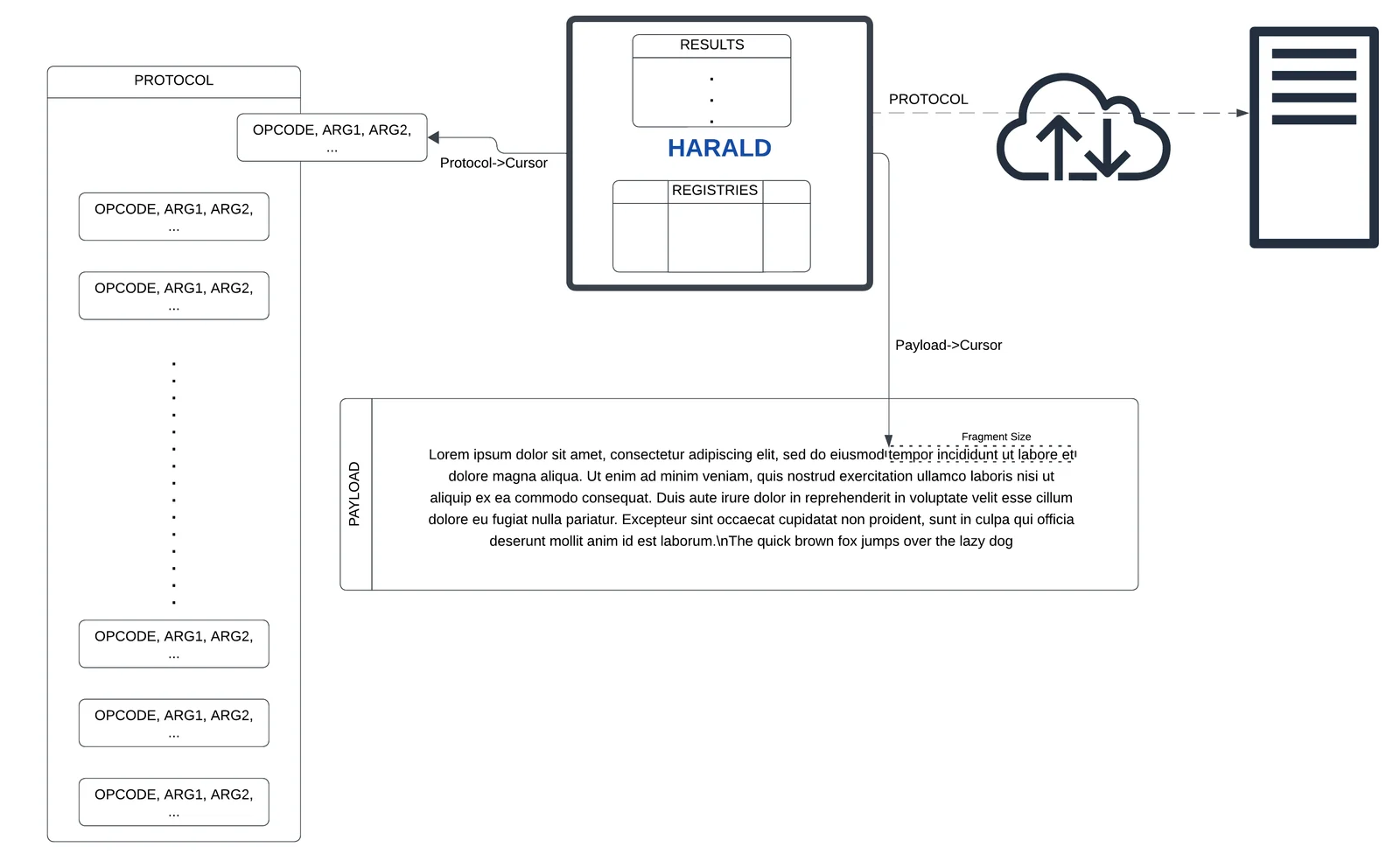
Harald supports a variety of Opcodes to be provided as a protocol. Harald will perform a set of high-level operations upon receiving a given Opcode. Each Opcode expects a predefined set of arguments with a predefined length.
| OPCODE::Nº | Description | ARGS::Size |
|---|---|---|
| H_F_APPEND::0x01 | Appends the following N Bytes to the end payload | Size::4, NBytes::N |
| H_F_PREPEND::0x02 | Prepends the following N Bytes to the end payload | Size::4, NBytes::N |
| H_F_SPLIT::0x03 | Splits the Payload in fragments of the given size | Size::4 |
| H_F_PAYLOAD_INJECT::0x04 | Injects the Payload fragment into the End Payload | - |
| H_F_SOCK_INIT::0x05 | Initializes the socket connection | IsIPAddress:1, SSL_Enabled::1, TCP/UDP::1, [(HostLen::4,HostName:N)/IPAddress::4], Port::2 |
| H_F_SEND::0x06 | Sends the constructed End Payload | - |
| H_F_RECV::0x07 | Receives up to N Bytes | Size::4 |
| H_F_CLOSE::0x08 | Closes the socket and cleans | - |
| H_F_INJECT::0x09 | Injects the requested registry into the End Payload | Reg::1 |
| H_F_ENCODE_STR::0x0A | Encodes a Payload field to its string representation | IsReg::1, [(Payload::1, Field::1)/Reg::1], Format::1 |
| H_F_DECODE_STR::0xA0 | Decodes the contents of a registry to its numeric representation | Reg::1 |
| H_F_ENCODE_STRB64::0x0B | Encodes a Payload field to its B64string representation | Payload::1, Field::1 |
| H_F_COMPUTE_FRAG_LENGTH::0x0D | Calculates the next fragment to be sent length | - |
| H_F_SEARCH::0x0E | Searches for a given byte pattern of a given N size in a given registry | Reg::1, Size::4, NBytes::N |
| H_F_SEEK::0x0F | Moves the cursor in a given payload by a given number of bytes | Payload::1, Offset::4 |
| H_F_PUSH::0x10 | Pushes a number of bytes or the contents of a registry into another registry | IsReg::1, [Size::4, NBytes::N]/SrcReg::1, DstReg::2 |
| H_F_ADD::0x12 | Adds two registries or a number to a registry | IsReg::1, [Size::4, NBytes::N]/SrcReg::1, DstReg::2 |
| H_F_SUBSTRACT::0x13 | Substracts two registries or a number to a registry | IsReg::1, [Size::4, NBytes::N]/SrcReg::1, DstReg::2 |
| H_F_READ::0x14 | Reads from a given registry up to the length stored in another registry | FromReg::1, SizeReg::1 |
| H_F_STORE::0x15 | Stores a registry value into Harald's Storage | Reg::1 |
The following Opcode stream will generate the required data to be sent for a communication be understood as HTTP. It will initiate, modify the payload to look like HTTP traffic, send it over an SSL/TLS connection, and close the connection at the end.
H_F_SPLIT, 0x00, 0x00, 0x00, 0xFF,                         // Splits the Payload
H_F_APPEND, 0x00, 0x00, 0x00, 0x46,                           // Appends...
  'P', 'O', 'S', 'T', ' ', '/', ' ',                              // POST /
  'H', 'T', 'T', 'P', '/', '1', '.', '1', '\r', '\n',             // HTTP/1.1
  'H', 'o', 's', 't', ':', ' ',                                   // Host:
    'd', 'o', 'm', 'a', 'i', 'n', '.', 'c', 'o', 'm', '\r', '\n', // domain.com
  'C', 'o', 'n', 'n', 'e', 'c', 't', 'i', 'o', 'n', ':', ' ',     // Connection:
    'c', 'l', 'o', 's', 'e', '\r', '\n',                          // close
  'C', 'o', 'n', 't', 'e', 'n', 't', '-',                         // Content-
    'L', 'e', 'n', 'g', 't', 'h', ':', ' ',                       // Length:
H_F_COMPUTE_FRAG_LENGTH,                                 // Next Fragment's size
H_F_ENCODE_STR, H_PAY_END_PAYLOAD, H_PAY_FRAGMENT_SIZE, 'u',  // FragSize encode
H_F_INJECT, H_REG_RET,                   // Inject the Fragment Size encoded str
H_F_APPEND, 0x00, 0x00, 0x00, 0x04, '\r', '\n', '\r', '\n', // Append Body begin
H_F_PAYLOAD_INJECT,                                        // Inject the Payload
H_F_SOCK_INIT, 0x01, 0x01, 0x7F, 0x00, 0x00, 0x01, 0x04, 0xD2,    // Init Socket
H_F_SEND,                                    // Send the Payload over the socket
H_F_CLOSE                                        // Close the socket and cleanup
